Solar panels, plug-in solar & battery storage for Yorkshire homes Talk to us: 01845 591162
Plug-in solar panels · UK

Plug-in solar panels from £1,000 fully fitted.

Generate useful electricity at home without committing to a full rooftop solar installation. A compliant plug-in solar system can deliver up to 800W into the home, helping cover the everyday background loads you are already paying for.

No-obligation enquiry Yorkshire focused
Two compact plug-in solar panels mounted neatly on a British brick home with a microinverter and outdoor socket connection
From £1,000 fully fitted
Up to 800W AC output
Around 500–800kWh a year in a suitable position
No conventional rooftop PV installation required
What to know before you buy

Make the system fit the home, not the other way around.

01

Start smaller than conventional solar

Plug-in solar gives households a lower-cost way to generate their own electricity. It can suit homes where a full rooftop array is too expensive, too large for the brief or simply not the first step you want to take.

02

Use the electricity as it is generated

The biggest value normally comes from using the solar electricity in the home while it is being produced. Fridges, broadband, computers, TVs and other background loads can all reduce how much electricity you need to buy from the grid.

03

Up to 800W, not 800W all day

800W is the maximum AC output. Real generation rises and falls with daylight, orientation, season, shading and weather. A good sunny position matters far more than a headline panel wattage.

04

A proper approved installation

We use the compliant product route and assess the mounting position, cable route and existing electrical installation. If fixed electrical remedial work is needed, that is dealt with separately by a suitably qualified electrician.

PLUG-IN SOLAR COST

From £1,000 fully fitted.

We want the price to be as easy to understand as the product. Our fitted plug-in solar packages start from £1,000 for a suitable straightforward installation.

Final price depends on the approved kit, mounting system, access, cable route and the condition of the existing electrical installation. Any electrical remedial work or specialist access is quoted separately.

Get a fitted price
FROM£1,000

What the standard fitted package is built around

  • Compliant plug-in solar kit
  • Approved mounting system
  • Microinverter / power electronics
  • Neat cable route and connection
  • Basic electrical suitability checks
  • DNO registration guidance
HOW MUCH ELECTRICITY DOES IT MAKE?

Small system. Useful amount of energy.

An 800W plug-in system will not run an entire house, but it can make a noticeable dent in the electricity you buy every day.

500–800kWhTypical annual generation

Depending on location, orientation, angle and shading.

Up to ~2kWh/dayAverage at the stronger end

Summer days can be much higher. Winter days will be lower.

20%Up to this share of average home electricity use

Government modelling for a suitable 800W plug-in system.

£132–£211/yrValue of 500–800kWh at 26.32p/kWh

If every generated kWh offsets electricity you would otherwise buy from the grid.

These are indicative figures, not a generation or savings guarantee. At Ofgem's current average capped electricity rate of 26.32p/kWh, 500–800kWh of generation is worth roughly £132–£211 if every unit is used in the home and directly replaces imported electricity. The government's separate headline modelling says households could save up to £110 a year, which uses more conservative assumptions and should not be treated as a hard ceiling on the value of the electricity generated.

WHAT CAN 800W ACTUALLY POWER?

Think background electricity first.

At strong output, an 800W system can cover a surprising amount of the low-power equipment that quietly runs around your home all day. If a larger appliance needs more than the solar is producing, the grid simply supplies the difference.

Typical lower-power loads
Broadband router~10W
Laptop~50W
LCD television~120W
Desktop computer~140W
Fridge or freezer~150W each
Dehumidifier~500W
Example sunny moment

800W being generated

A fridge, broadband router, laptop, television and a handful of LED lights can all potentially sit comfortably inside that level of generation, depending on the actual appliances and whether thermostatic loads are running.

Illustrative example only. Appliance ratings vary.
Higher-power appliances
Vacuum cleaner~900W
Microwave~1,000W+
Washing machine while heating~2,100W
Oven~2,100W+
Kettle~3,000W
Electric shower~9,000W

The solar still contributes. If a 2,100W appliance is running while solar is producing 700W, the home only needs to import the remaining demand from the grid.

WHAT DOES 2kWh MEAN IN REAL LIFE?

Translate the generation into things you recognise.

At the stronger end of typical annual performance, around 2kWh of generation in a day is roughly the same amount of energy as:

≈ 4washing-machine loadsat around 0.5kWh each
≈ 2dishwasher cyclesat around 0.9kWh each
≈ 10full kettle boilsat around 0.2kWh each
≈ 40 hrsof a 50W laptopenergy-equivalent

This is an energy-equivalent comparison, not a claim that all of these appliances can be powered directly at the same time. Solar output changes through the day, while appliance demand changes as devices cycle on and off.

25-YEAR RETURN

What happens if electricity keeps getting more expensive?

We have modelled a £1,000 plug-in solar installation over 25 years using 730kWh of first-year generation, 80% self-consumption, 0.5% annual panel degradation and a £250 mid-life maintenance allowance. The 3% electricity-price line is our base case.

Installed cost£1,000
Year-one generation730kWh
Base-case self-use80%
Starting electricity rate26.32p/kWh
We also allow £250 in year 15 for possible maintenance or microinverter replacement. It may never be needed, but including it makes the model more useful.
Base case: 3% annual increaseLow case: flat electricity price2001–2025 historic trend: 6.52%Break-even
-£1k£0£2k£4k£6k£8k202620302035204020452050
Base case · 3% annual increase~£4,000 net

After the £1,000 starting cost and £250 maintenance allowance. Modelled simple break-even is around 2032.

Low case · flat prices~£2,400 net

If electricity never rises above 26.32p/kWh, while the same degradation, self-use and maintenance assumptions apply.

Historic trend scenario~£7,200 net

If the 2001–2025 ONS electricity-price trend repeated. This is a scenario, not a prediction.

Home during the day?

If a household managed 90% self-consumption instead of our 80% base assumption, the same 3% price-growth model rises to roughly £4,650 net benefit over 25 years.

Why we show more than one forecast

The ONS electricity price index rose from 128.0 in 2001 to 582.5 in 2025, equivalent to roughly 6.52% annual growth over that period. That history includes exceptional events such as the 2022 energy-price shock, so simply carrying 6.52% forward for another 25 years would be aggressive. The middle 3% line is there to give homeowners a more restrained comparison.

At 3% annual growth, the modelled electricity rate moves from 26.32p/kWh today to roughly 53.5p/kWh by 2050. If the old 6.52% trend repeated, it would reach roughly £1.20/kWh. Nobody knows the actual 2050 price, which is why these are labelled scenarios rather than promises.

Sources: Office for National Statistics electricity price index, 2001–2025; Ofgem average Direct Debit electricity unit rate for 1 October–31 December 2026. Returns are illustrative. The model includes a £250 maintenance allowance but excludes finance, export payments and future tax or tariff changes.

HOW PLUG-IN SOLAR WORKS

Sunlight becomes electricity your home uses first.

01

The panels generate DC electricity

One or two compact solar panels capture daylight from a suitable sunny wall, patio, balcony or other approved position.

02

The microinverter converts it

The approved microinverter converts the panel output into AC electricity that matches the household supply, with output limited to the compliant level.

03

Your home uses it immediately

The solar reduces the amount of electricity the home needs to import from the grid while the system is generating.

04

The grid fills any gap

Nothing special happens when you need more electricity. The grid automatically supplies whatever the plug-in solar is not covering.

Where plug-in solar can make sense

You do not need a perfect south-facing house roof.

The new category is particularly useful where a full rooftop installation is too expensive, too involved or simply more solar than you want to buy.

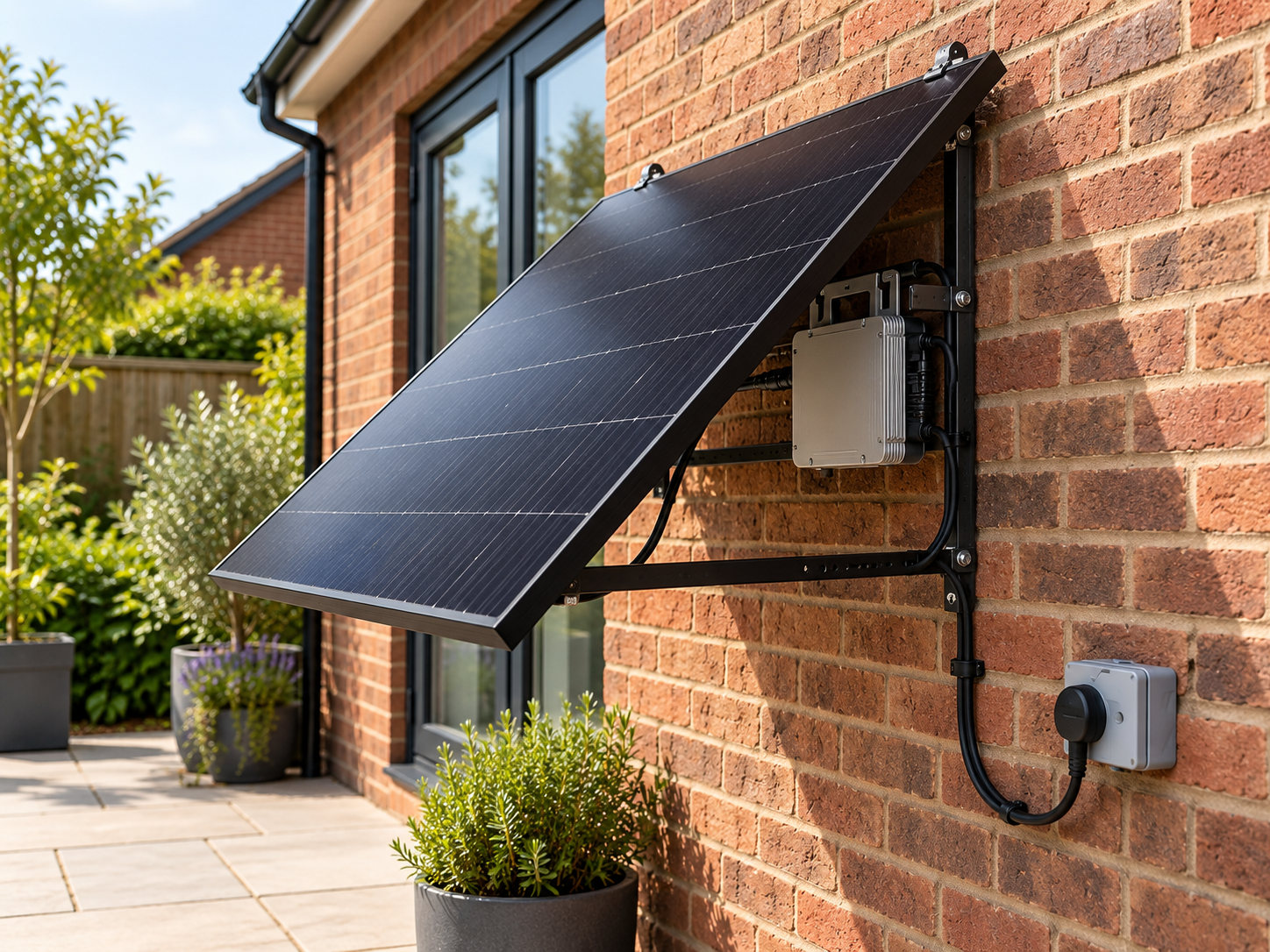
Single plug-in solar panel mounted neatly on a British brick wall with visible microinverter and outdoor socket connectionWall-mounted solar

Sunny walls and outbuildings

Where the product and mounting system allow it, a compact wall-mounted setup can keep the panels, microinverter and cable route neat without committing to a full rooftop installation.

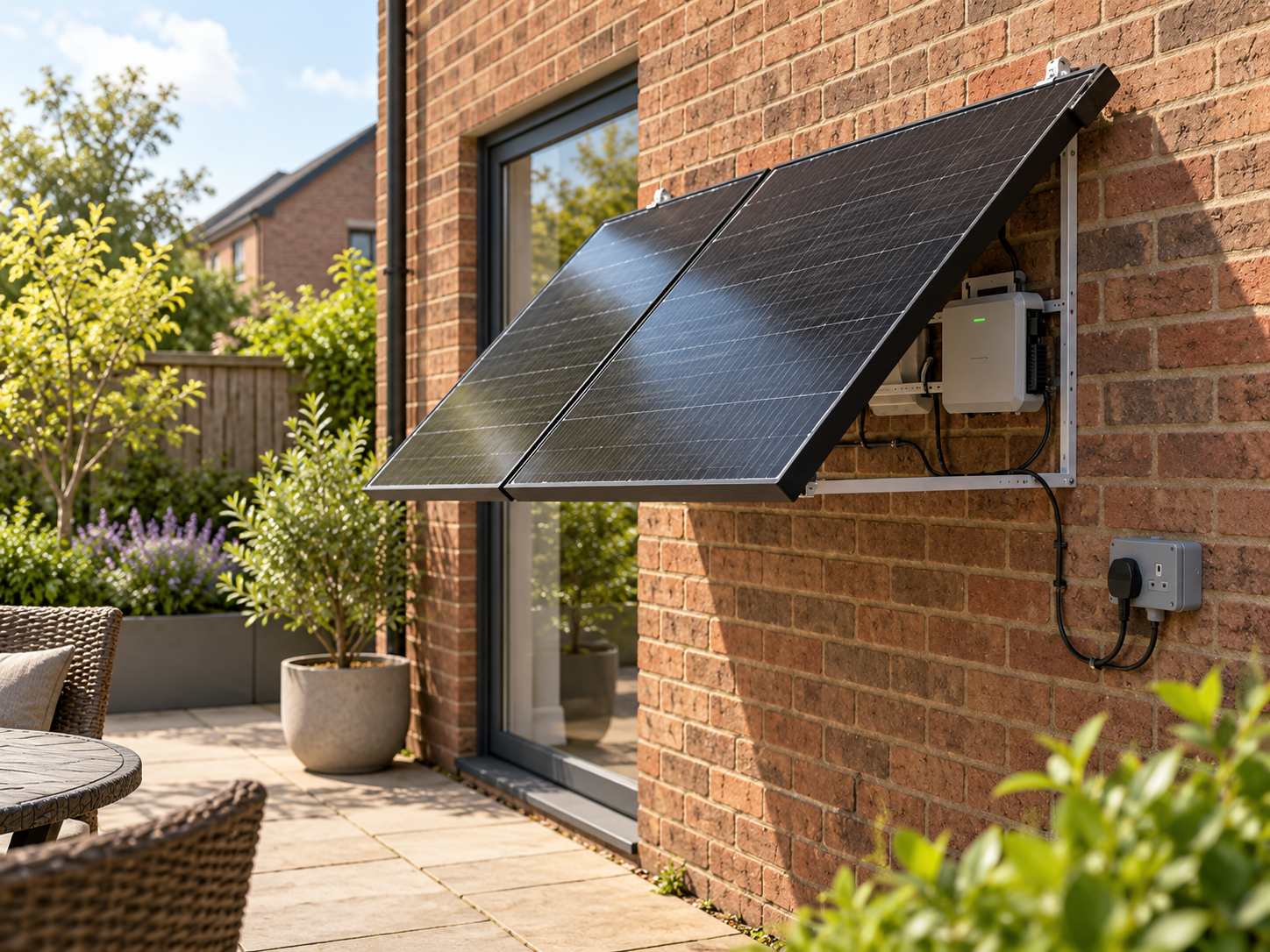
Two plug-in solar panels mounted on a British brick home beside a patio with a compact microinverter and outdoor socketTwo-panel setup

Patios and outdoor spaces

A two-panel approved kit can make good use of a sunny patio, wall or other suitable outdoor position while keeping the system far smaller and simpler than a conventional rooftop array.

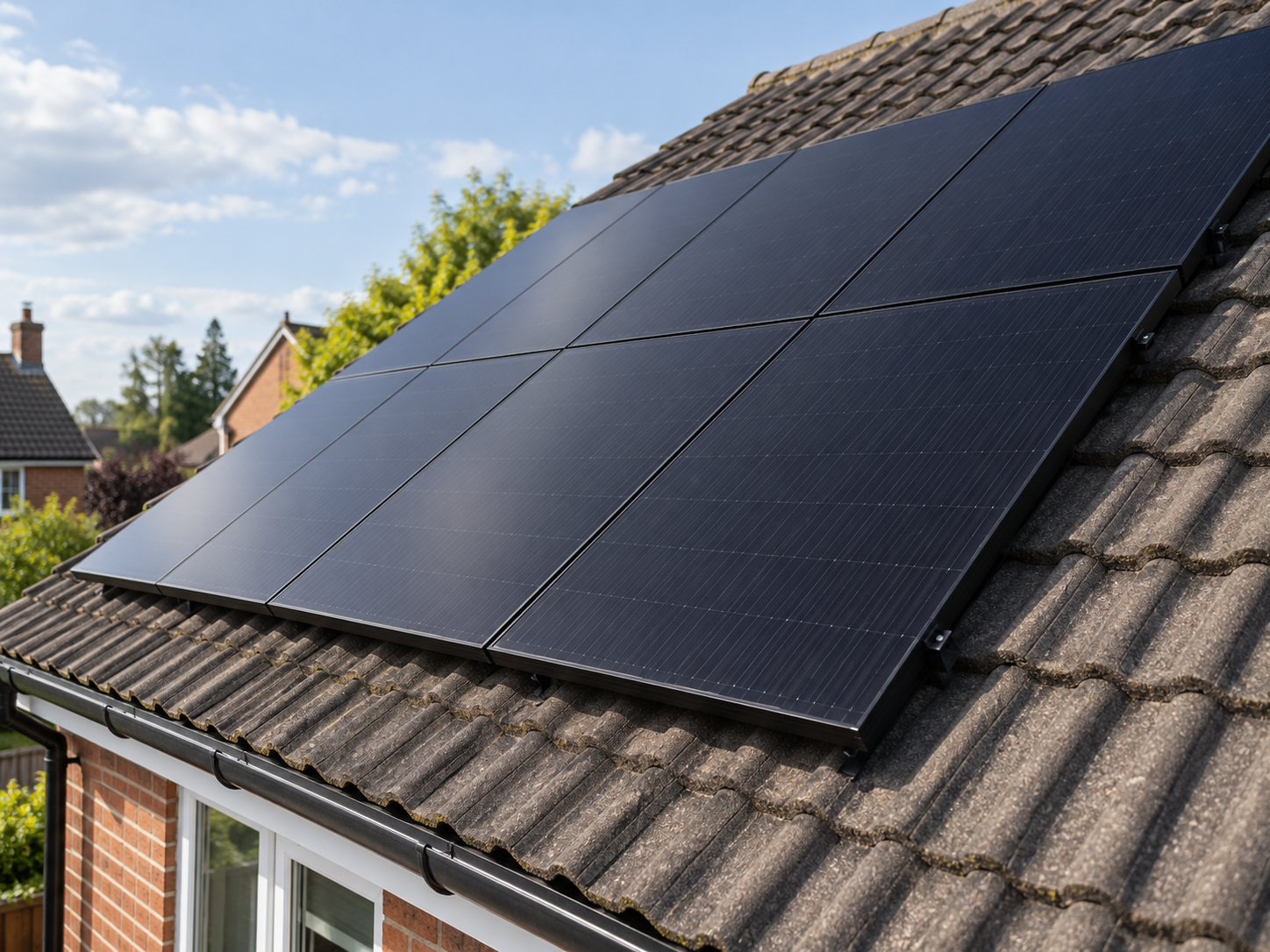
All-black solar panels showing the difference between conventional rooftop solar and smaller plug-in solarStart smaller

A lower-cost way into solar

For households that are not ready for a conventional multi-kilowatt rooftop system, an approved plug-in device creates a much smaller first purchase while still reducing grid electricity use during generation.

Plug-in solar UK FAQs

Everything homeowners normally want to know before buying.

How much do plug-in solar panels cost?+

Goldridge plug-in solar packages start from £1,000 fully fitted for a suitable straightforward installation. The final price depends on the approved kit, mounting method, access, cable route and whether the existing electrical installation needs any remedial work.

How much electricity will an 800W plug-in solar system generate?+

A typical 800W system may generate roughly 500–800kWh a year depending on location, panel orientation, angle and shading. At the stronger end of that range the annual average is around 2kWh per day, with much more generation in summer and less in winter.

What can an 800W solar system power?+

At strong output, 800W can comfortably cover many lower-power household loads such as broadband, laptops, TVs, computers and refrigeration. High-power appliances such as kettles, ovens and electric showers need considerably more than 800W, but the solar can still contribute and reduce what is imported from the grid.

Are plug-in solar panels legal in the UK?+

Compliant plug-in solar devices became legal to buy and use in Great Britain from 27 August 2026. The device must meet the applicable UK plug-in solar product requirements rather than simply being a generic overseas balcony-solar kit.

How powerful can plug-in solar be?+

The legal definition of a plug-in microgenerator caps its rated alternating-current output at 800W. The solar modules can have a different combined DC nameplate rating, but the device must remain within the approved AC output limit.

Do I need an electrician to install plug-in solar?+

The compliant product category is designed so ordinary consumers can make the plug-and-socket connection when the existing electrical installation and mounting location are suitable. If the consumer unit is old, unclear or of unknown condition, or if fixed electrical alterations are needed, a qualified electrician should assess or complete that work.

Do I need MCS for plug-in solar?+

A compliant plug-in solar device is a different route from a conventional MCS rooftop installation. The product itself must meet the plug-in solar requirements and the network-registration obligations still need to be followed.

Can plug-in solar include a battery?+

Not under the current plug-in solar framework. The present UK rules and interim product specification apply to plug-in solar products, not plug-in battery-storage products.

How much can an 800W plug-in solar system save?+

It depends on generation and how much of it you use yourself. At Ofgem's current average capped electricity rate of 26.32p/kWh, 500–800kWh of self-consumed generation has a simple electricity value of roughly £132–£211 a year. The government's separate policy modelling uses more conservative assumptions and quotes savings of up to £110 a year.

How long does plug-in solar take to pay for itself?+

There is no honest fixed payback period because generation, electricity prices, self-consumption and installed cost vary. If a £1,000 system generated around 730kWh a year and every unit replaced electricity bought at 26.32p/kWh, the simple electricity value would be about £192 a year, which is just over five years on a simple undiscounted basis. Real-world payback can be longer if generation or self-consumption is lower.

What happens if my home needs more than the solar is producing?+

Nothing changes for you. The home uses the solar electricity that is available and automatically imports the balance from the grid. If the panels are producing 600W and the home is using 1,000W, the remaining 400W comes from the grid.

START WITH A PHOTO

Could plug-in solar work at your home?

Send us your postcode and photographs of the sunny wall, patio, balcony or garden position. We can quickly tell you whether it looks worth taking further.

Get my plug-in solar price
Start with your property

See whether plug-in solar suits your home.

Send us the postcode and a couple of photographs of the wall, patio, balcony or outdoor area you have in mind. We can tell you whether the position looks sensible and what the fitted price is likely to be.

  • No obligation
  • About a minute to complete
  • We only ask for information that helps with the quote
Solar quoteStep 1 of 3
First, tell us about the property

Could solar work for your home?